Weiqi (Go)
The Essence of Weiqi (Go)
Weiqi (known as Go in the West) is an ancient, two-player abstract strategy board game that originated in China over 2,500 years ago. Despite having incredibly simple rules, it is renowned for its profound strategic depth, vastly exceeding chess in its number of possible board combinations.
The game is fundamentally about territory and efficiency: players take turns placing stones on a grid with the objective of surrounding more empty space than their opponent.
Core Mechanics & Components
1. The Board and Pieces
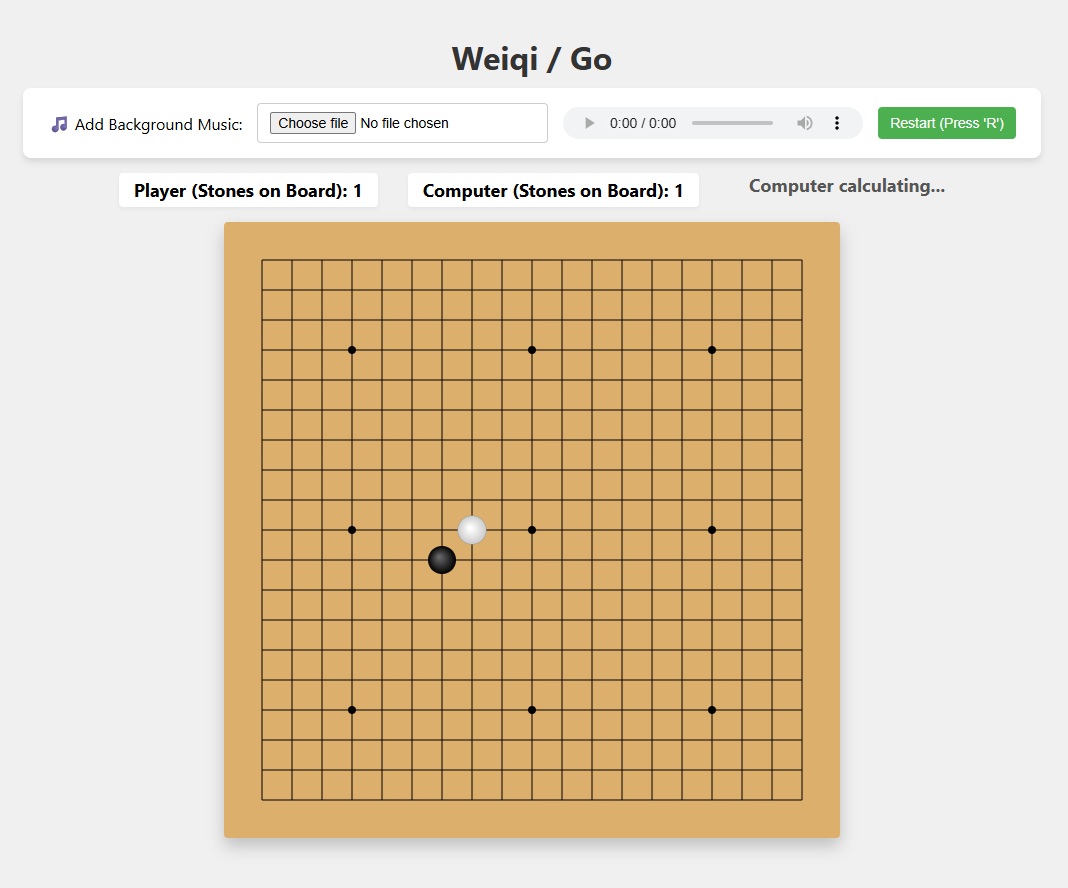
- The Grid: The standard game is played on a 19x19 grid of intersecting lines. Beginners often practice on smaller $9\times9$ or $13\times13$ boards.
- The Intersections: Unlike games where pieces sit inside squares, Weiqi stones are placed directly onto the intersections of the lines. Once placed, stones do not move unless they are captured.
- The Stones: One player commands the Black stones (who always plays first), and the other commands the White stones.
- Star Points (Hoshi): The nine dark dots printed on the board serve as visual reference points and are used as starting locations for stones in handicap games.
2. Liberties and Life
The most critical concept in Weiqi is the Liberty—any empty intersection immediately adjacent (up, down, left, or right, but not diagonally) to a stone or a connected group of stones.
- Connection: Stones of the same color placed on adjacent intersections merge into a single, collective group. They share their liberties.
- Capture (Atari): If a stone or a connected group is completely surrounded by opponent stones so that it has zero liberties left, it is captured and removed from the board. When a group is down to its final liberty, it is said to be in Atari (similar to "Check" in chess).
3. The Concepts of "Life and Death"
To ensure a group of stones can never be captured, players attempt to form eyes—enclosed empty spaces within their groups.
- A group with only one eye can eventually be surrounded and captured.
- A group with two separate eyes is permanently safe ("alive") because the opponent cannot occupy both empty spaces simultaneously without committing an illegal "suicide" move.
Objective and Scoring
The game ends when the board is filled to the point where no more profitable moves can be made, and both players agree to pass.
Winning is determined by totaling up each player's score. There are two primary methods of scoring:
- Area Scoring (Chinese): A player's score is the number of empty intersections they have completely surrounded, plus the number of their own stones occupying the board.
- Territory Scoring (Japanese): A player's score is the number of empty intersections surrounded, minus the number of their stones that the opponent captured.
What is Komi?
Because going first gives Black a distinct natural advantage, White is awarded a compensation score called Komi (typically 6.5 or 7.5 points) at the end of the game. The fractional 0.5 points ensures the game cannot end in a tie.
Strategy: Influence vs. Territory
Weiqi is a balancing act between local tactical battles and global strategy:
- Territory: Securing low-risk points early on, usually along the corners and edges of the board where it requires fewer stones to surround space.
- Influence: Placing stones toward the center of the board. This doesn't secure immediate territory but creates structural power that can be used later to attack opponent stones or build massive frameworks (Moyo) in the mid-game.
Leave a comment
Log in with itch.io to leave a comment.